Going-Back-in-Time Perspective: When Travel was Still a Voyage

Updated: 10 hours ago
We’re revisiting a very different kind of travel — the unpredictable, sensory voyage of the 1980s. In Part 1 of our series we follow Harry van Iperen’s Far East notebook as he and his wife Ursula navigate packed markets, ‘Superdeluxe’ buses, roadside banana leaf meals and temples that stop you in your tracks. It’s not nostalgia for nostalgia’s sake, but a reminder of why slow, attentive travel reshapes how we see the world.

Editor's Note: The following travelogue was written in the 1980s by a Dutch author, Harry van Iperen, who travelled with his wife Ursula, and is presented here as a historical time capsule. Today, travelling to the other side of the world can feel as routine as buying a loaf of bread. This story takes us back to a bygone era when global travel was still a genuine, unpredictable voyage into the unknown—unplugged from smartphones, GPS, and modern tourism. While some observations regarding infrastructure and local customs reflect the outdated tropes and Western perspectives of late-20th-century backpacking, they have been lightly polished to preserve the author’s original sense of wonder, curiosity, and classic Amsterdam wit. Contemporary images have been included to echo the timeless energy of the routes travelled.
Part 1, India: "Insanely captivating, deadly exhausting and really unforgettable."
We've just got back from a trip through South India, and everyone is asking us how it was. How can you explain this to someone who has never been to India? Still, I want to give it a try. Picture the 'Kalverstraat' in Amsterdam or the 'Lijnbaan' in Rotterdam. As far as I'm concerned, it could also be the 'Spui' in The Hague. In any case, a busy shopping street on a Saturday afternoon just before Christmas. 'Terribly busy,' you might say. Ha ha, don't make me laugh.
"'Terribly busy,' you might say. Ha ha, don't make me laugh"
Picture This: An Ordinary Street in India
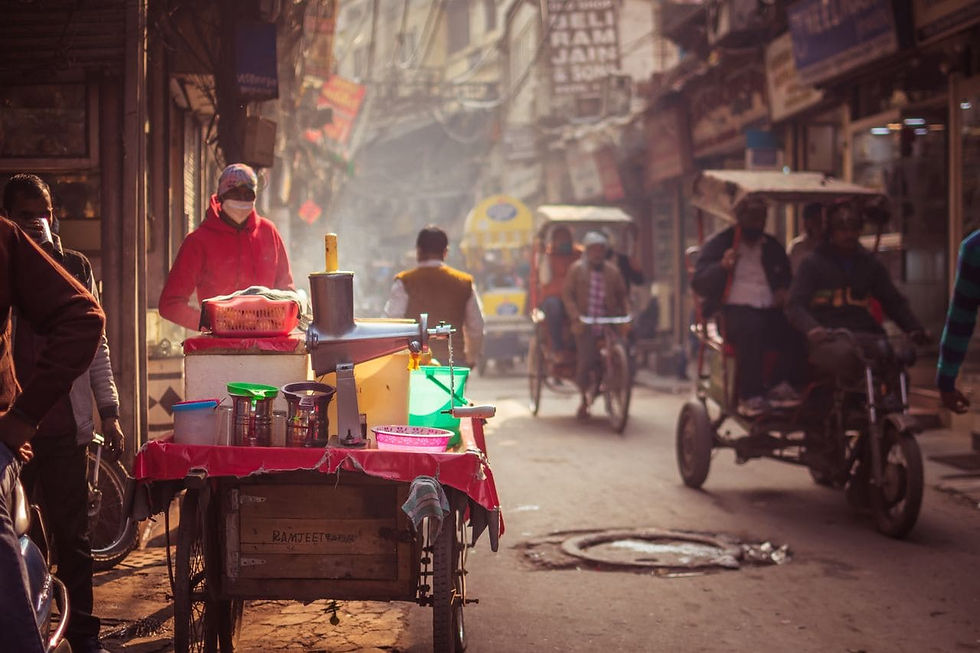
Now let's picture the scene. In our minds, we are now going to make it an 'ordinary street in India,' say somewhere in Mamallapuram*. First we have a battalion of tanks drive around there for a week, in order to obtain the right type of road surface. Next, we build the shops. They will be cubicles measuring one by two meters, made of wood. We leave the front of the booths open. We put a small thatched roof on top of each one, and on top of that a huge billboard painted in bright colours, preferably with something like 'New,' 'Hall' or 'Imperium' on it, not to mention 'In & Export.'
And then we stuff those cubicles with bananas in the colours yellow, green, brown and red, and a dazzling amount of large glass jars full of shiny, bright red and yellow sweets. Here and there we put rickety wooden stalls or carts in the middle of the street, loaded with pineapples, apples and coconuts, just because we can.
Although the picture is far from complete, let's leave it at this for a while and move on to street traffic. Here you have to imagine, in a street of 150 meters long: About 20 approximately 30-year-old buses, 60 taxis of the 1950s model, 80 scooter taxis, 100s of bicycles, scooters and mopeds and 20 ox carts. Now add about 50 stray cows, a few donkeys and horses, two camels, an elephant, countless goats and a handful of monkeys.
Are you still there?

Quite a Voyage: Superdeluxe Express
But, before we send this mob out onto the street that I've just described, let's take a bicycle taxi for a few rupees to the bus station from where our bus will depart later that morning. Both the first and second stations where we will arrive with this bus will probably be the wrong ones. After half an hour we will arrive at the right bus station, a three-minute walk from our starting point. Now for half an hour we have to search for the right counter, where with a bit of luck, after an hour of waiting, we can get a few tickets for reserved places in a bus that leaves in three days. According to the tickets, with a 'Superdeluxe Express' bus.
The word 'Superdeluxe', by the way, means that there are a few things on the bus that we hardly dare to call seats. The bus company calls them, in some cases, 'airplane seats.' If I was ever offered a lift from an airline that flies over the Sahara with seats like that, I think I'll walk.
"If I was ever offered a lift from an airline that flies over the Sahara with seats like that, I think I'll walk."
The More the Merrier
The word 'Express' by the way, means that you are guaranteed to get there faster than with an ox cart. I think the bus's shock absorbers have already been removed from underneath. If not, they have not been usable for at least 10 years. The springs, however, have been doubled because nobody believes in the official passenger limits; the unwritten rule of the road is always: 'The more, the merrier.'
Windows are not usually present. If they are, then you have to be careful. It is best not to touch them. Trying to slide them open or closed means you'll probably be left with the window in your hand, and the wooden frame somewhere on the ground. If it hasn't disappeared through any of the holes in the floor, that is.
No problem!!! In India, you just place the window next to you, or under your airplane seat, and continue to look outside.

Special Tourist Bus
In addition to these luxury buses, there are also special tourist buses, the so-called 'video coaches.' Not only is it difficult to find out from where and at what time they leave, there is something else going on with this kind of transport. Once you find yourself reasonably comfortable, reclined in your 'airplane seat,' a sound will hit you—the kind that a jumbo jet wouldn't be ashamed of.
From six large loudspeakers, a booming wall of music attempts to surpass the cacophony of sounds from the street. And they succeed magnificently. After a ride in such a bus, I was always left somewhat disturbed.
In any case, noise is quite normal in India. This, along with the bumpy roads, the state of the buses, and the massive crowds, makes travelling in India a deadly tiring affair. A great resilience is therefore one of the most important qualities that an India-goer must possess.

One Hand on the Steering Wheel, the Other on the Horn
But anyway, on the day of this departure we are in this 'Superdeluxe' bus one hour before departure, otherwise the reserved seat is, well, no longer reserved. Outside it is forty degrees Celsius; inside it is slightly warmer. We drink a very, very sweet lemonade for a few rupees, or if we're lucky, a cooled bottle of mineral water, which is six times more expensive. Anyway, we have something to drink, that's the main thing.
As almost always, the driver gets in very late. Because we don't share a common language, we sometimes only know for sure at the end of the ride whether we have been on the right bus. The driver begins to check his metre gauges. Why he does this is a bit of a mystery, because none of the dozens of buses we rode in had a single gauge working. Anyway, at least he's starting to look. I guess it's good for something.
Then he yanks on a wire somewhere under the steering wheel, after which the bus starts to vibrate and shake at its seams. A mighty noise fills the bus. The driver starts to shift gears with even more noise. One hand on the steering wheel, the other on the horn. From now on there will be as little shifting gears as possible, because shifting means letting go of the horn, and that is a mortal sin in India. And then a miracle happens! Something happens that I cannot explain.
"And then a miracle happens! Something happens that I cannot explain."

An Inexplicable Miracle
Now you have to remember again all those buses, carts, taxis, cyclists, cows, ox carts, donkeys and monkeys and let them run free among the thousands of people who walk through your imagined version of a busy shopping street. Everything is now swarming, trying to make as much noise as possible, and that's what the bus we're on is driving directly into. The fact that the bus can start driving is already a miracle, but the greatest miracle is that it also continues to drive. You can believe me or not, but it actually happens. In an ordinary Amsterdam Kalverstraat there would be only two scenarios: there would be chaos, or the bus would be stuck within minutes.
But here, once a bus starts driving, well, it simply continues to drive. You won't hear me say it's going fast, but the advantage of driving slowly is that you get time to take in everything there is to see on the street. And that is something unimaginable. With bulging eyes and open mouths, we often sat in a daze watching the circus in the street.
What to say about a high-wheeled ox cart, piled high with coconuts? Or an elephant that is walking thirty centimetres away from your window, so close that you can't miss the distinct aroma. Cows that continue to move, unfazed, hoof by hoof, across the road, or, better yet, that decide to lie down right in the middle of the pavement. A herd of goats that suddenly comes out of a side street in the middle of the city.
"You won't hear me say it's going fast, but the advantage of driving slowly is that you get time to take in everything there is to see on the street."
There Are No Words For It
We would sit and watch in awe as the driver continued to drive and, not to forget, continued to honk the horn. To our amazement, a whirlpool of furry goat bodies would form on both sides of the bus that, without a single animal being hurt, would just flow back together just behind the bus. It is impossible to describe this pandemonium. The written or spoken word falls short for that. You need all your senses.
Can you imagine, for example, that a couple of stray pigs want to walk into the premises of the V&D [Editor: A large historic Dutch department store] and the owner chases them out again, without worrying about anything, with a simple wave of the hand? They don't complain, do not call the police, do not set up an anti-pig association and do not request the municipal council to appoint a committee to combat unwanted pig visits.
"It is impossible to describe this pandemonium. The written or spoken word falls short for that. You need all your senses."
Out of Town
The cityscape in India is insanely captivating, deadly exhausting and unforgettable. But let's see what it's like out of town. Our bus leaves houses and local shacks behind. On the road it gets quieter and quieter. Some buses, a few antique trucks and some cyclists remain. Donkeys and ox carts join in. Unfortunately, the road surface remains rough for a while and the bus drive seems to be getting even more turbulent, but the landscape is beautiful.

Green, silky plantations punctuated by small pools where water buffalo bathe in silence. All this surrounded by sky-high palm trees, mighty rivers, and jagged mountains. Sleepy villages where small groups of women in brightly coloured saris stand talking. Little children waving at us. And then just somewhere in the middle of the landscape, just like that, a beautiful temple, about which we would keep asking ourselves: How did they ever make it? The same goes, of course, for the dazzling palaces we see.
Meanwhile, the bus shakes and bounces imperturbably from one panorama to the next. When the bus driver, despite having a clear view of oncoming traffic, continues to drive on the right side of the road until the very last second before an oncoming vehicle passes, my wife would suddenly remember all kinds of prayers from her Roman Catholic youth. I used to join her on the Indian night rides. In those moments, I just couldn't imagine ever being able to report on our travel experiences again.
"And then just somewhere in the middle of the landscape, just like that, a beautiful temple, about which we would keep asking ourselves: How did they ever make it?"


Putting Things into Perspective
But let me stick with the ride I'm taking with you in my mind. For the sake of convenience, let's map it onto a route from Amsterdam to Maastricht. Because when I tell you that we are on our way from Mahabalipuram to another ancient city in the same state, Tiruchirappalli (a mouthful for any foreigner!) it tells you nothing and it won't help you imagine how long the drive will take.
If you leave Amsterdam for Maastricht [Editor: about 213 kilometres] at about nine o'clock in the morning, then you will be sitting on the Vrijthof square in Maastricht for a coffee with a large piece of local Limburg pie at about one o'clock. Unfortunately, in India you would be, if all goes well, approximately as far as Den Bosch [about 88 km], and certainly not behind a large piece of Limburg pie.
Can you still follow me? Then let's move on.
Things get Urgent
Our bus regularly stops at one of the many bus stations, where thousands and thousands of people are sitting very patiently, or more often resting on the floor, just waiting. When their bus finally arrives, all this patience suddenly vanishes and the passengers all want to get in at the same time. This means that they are not going to take into account that other passengers have to get off first. So, things become urgent. Keeping in mind that only the first few can get a seat. The rest often have to stand for hours or squeeze against each other. Anyway, we stop for the thirtieth time, but now the bus driver gestures to us that he is going to eat before we continue, and we understand that we have to do the same.
Thanks, We'll Stick to Bananas
The restaurant is packed immediately. How could it be any other way, in a country where hundreds of millions of inhabitants rely on local bus transit. Although we are often quite hungry, we can never quite bring ourselves to eat in such bustling roadside stations.
Banana leaves are laid out on the front tables. The servers quickly portion out mountain heaps of rice, alongside a variety of vibrant, heavily spiced curries. The local style is a matter of mixing and consuming all this expertly with the fingers of the right hand. Because traditional customs reserve the left hand strictly for personal hygiene, dining is strictly a one-handed affair.
Not being entirely accustomed to the local etiquette, we stuck to familiar bananas and apples on such occasions, catching up in the evenings in the hotels where generally good food was available. Especially on the coast, where we could feast on a large plate of grilled shrimp or a freshly prepared fish.


As Long As We Get There!
If the bus does not break down during the rest of the journey, and everything else goes well, we arrive at our destination in the evening. Everyone gets out, or comes off the roof, and tries to get to their luggage.
Following that, a number of scooter taxi drivers will start a seriously tough fight. Every one of the drivers tries to get you in his taxi. All the rickety vehicles are each equipped with a travel distance meter, but as soon as a tourist gets in they are chronically broken. The drivers adamantly refuse to use them, and a ride that normally would cost five rupees will probably be offered for fifty. We offer to pay twenty, eventually it will be thirty. We know we're being 'taken for a ride,' but we're usually so incredibly tired, dirty, and hungry that we don't care, as long as we get there!

Some Afterthoughts on India
For some, this report of our voyage could perhaps come across as negative, but we certainly did not experience India that way. I would call it realistic, in the sense that travelling through India triggers something in you—not just physically, but especially mentally. We often said to each other: "We Dutch love to complain, but we should look more often at life in countries like this." It helped us realise what an incredible welfare state we actually lived in.
India was an unforgettable experience that we would not have missed for the world. And that's why we will definitely go there again. Of course, the experiences I have described only shed light on a very small part of life in India. How all those millions of people live, work, and experience their culture and religion is extremely complex. To gain true insight into this, a stay of a few years would not be enough, let alone a few months.
"Travelling through India triggers something in you—not just physically, but especially mentally."
* Mahabalipuram, also called Mamallapuram, located in Tamil Nadu, India, is a historic coastal town and renowned UNESCO World Heritage Site famous for its 7th- and 8th-century rock-cut cave temples, monolithic chariots, and structural shrines built by the Pallava dynasty.

About the Author
The late Dutch author Harry van Iperen spent his later years in Spain with his wife, Ursula. For nearly thirty years, they dedicated themselves to helping animals in numerous Spanish shelters. He donated the proceeds from his book *Bas*—which tells the story of one of his dogs—to local shelters, encouraging people to adopt a shelter dog rather than choosing a dog of a popular breed. His love of travel stemmed from a lifelong passion for sailing that had begun in his teenage years.
Coming up next: Part 2, China: Harry's exploration of China in the 1980s, before the rise of tourism, unrestricted travel and skyscrapers.


